![]() |
![]() |
![]() |
![]() |
|
![]() |
|
|
||
|
Water enters a pipeline before commissioning usually due to lack of discipline at work during construction. In some cases, the reason may be the construction technology itself, for example where underground river crossings are laid which requires that the pipe be flooded with water. Hydrotests or stress-tests are another stage of construction when water enters a pipe. This is evident when the tests are carried out using water but we should not ignore tightness-tests using air when water contained in air condenses in the pipe after the air is compressed. Although some of the water is removed from the pipeline when it is cleaned, a significant proportion of water cannot be removed from the pipeline even when repeatedly applying mechanical cleaning techniques using water-absorbing cleaning pigs because the water adheres to pipe walls due to capillary forces. This water can only be removed by special drying techniques. |
![]() |
Both of these technologies can also be deployed for drying other pipelines facilities (metering stations, interconnecting nodes, etc.) or even pieces of equipment requiring a high level of dryness (chemical apparatuses, high-performance steam turbines, etc.). |
|
|
||
|
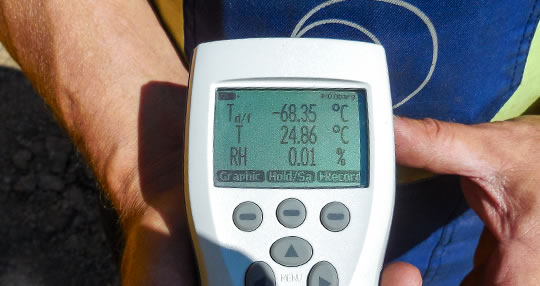
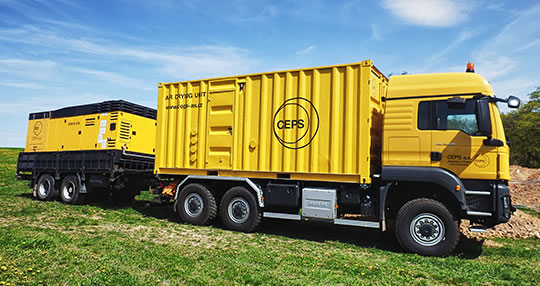
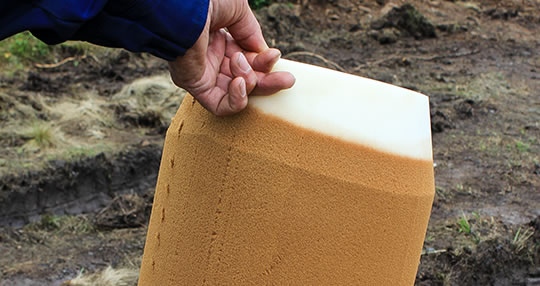
This technique is suitable for pipes made of steel and plastic materials, and also for process equipment. Air is first dried to a temperature of water dew point below minus 80 °C in a special unit based on a molecular sieve, and then blown into the pipeline being dried. The water, which is present in the line evaporates into the pre-dried air, and in this air is carried to outside the pipeline. CEPS has two units available. Each unit has a capacity of drying one cubic metre of air per second, i.e. 3,600 cu. m/hour. This is sufficient capacity to dry a pipeline having a nominal diameter DN 1400 (56") and a length of 10 to 15 km in one or two days. In case of need (particularly to speed up the drying process) both units can be connected in parallel. Both units are housed in containers and are transported on off-road vehicles capable of navigating difficult terrain, and therefore can be transported over the construction strip (r.o.w). The units’ operating pressure of 4 to 5 bar is strong enough to push porous cleaning pigs through the pipe during the drying process, which helps to achieve the high rate of drying. In forked/branched pipelines, or those whose dimensions vary significantly, or in process equipment, i.e. wherever the porous elements cannot be pushed through the equipment, the drying takes a proportionately longer time. The drying of a complex pipeline node, after the stress-test water has been simply released, would take several days. Pipes are dried to the standard level of the temperature of water dew point in the pipe of minus 20 °C. However, in case of need, particularly for process equipment, up to minus 70 °C can be achieved. |
![]() |
||
|
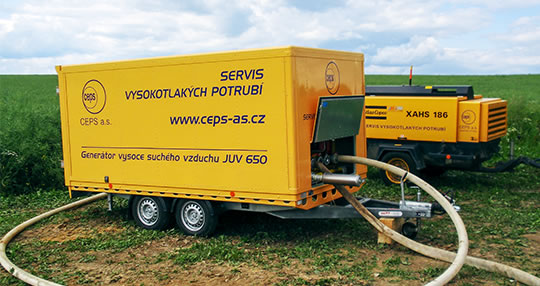
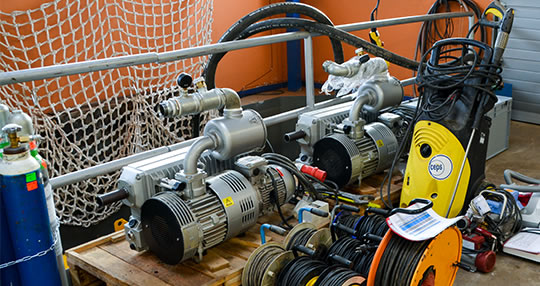
This approach is suitable particularly for uneven steel pipes and pipeline facilities of smaller sizes. For pipes having a nominal diameter of more than DN 500 (20"), the geometric stability of the pipes under deep depression always needs to be assessed. This technique cannot be employed with plastic pipes. In comparison with drying based on deeply pre-dried air supported by porous pigs pushed through the pipe, vacuum cleaning is slower. However, where the porous elements cannot be used, vacuum cleaning may even be faster for more complex pipeline nodes. Vacuum drying is based on a generally known physical phenomenon—as the pressure drops, also the boiling point of liquids drops. At an absolute pressure of about 2 kPa, water boils at the temperature of the soil that surrounds the pipe. The remaining water in the pipe therefore evaporates, and is exhausted from the pipe. CEPS operates two units, each with a capacity of 25 cu. m/hour. In case of need, both units can work in parallel. Vacuum drying is very appropriate for drying complexly shaped distribution network pipes because in addition to the drying itself, it also makes gas flow into the pipes much easier. The gas is let into vacuum and therefore there is no risk of an explosive mixture forming in the pipe, and the pipe need not be deaerated. |